A Firefighter’s Tears
By:
Kenda
*There’s little
I can say about the tragedies that occurred on September 11th, 2001,
that hasn’t been said far more eloquently by so many others. I was profoundly saddened when I watched an
episode of Oprah this week that centered on children’s fears and questions
as a result of the terrorist attack on our nation. Quite frankly, I was surprised at how much children between the
ages of six and ten understand about this tragedy, and in turn, how much it’s
affected them. These were neither
children who had lost a parent or family member on that day, nor children from
New York or Washington D.C. Instead,
these were kids from the Midwest whose fears encompassed the same things my
fears encompass and your fears encompass.
Possibly I recall my own childhood through rose colored glasses, or
possibly the way we are now given instant news reports twenty-four hours a day
on three-hundred channels has changed how much children are privy to. I don’t
recall having the insight to various events from my youth in anywhere near the
way the children of this new century have insight into what occurred on
September 11th. It touched
me in ways I can’t describe when a ten-year-old girl said she cried because of
all the children who lost a parent, or both parents, in that Tuesday’s
attack. Then there was the girl, no
more than eleven, who said she’s unable to sleep because of the haunting images
she saw on TV. And the weeping nine
year old boy who is so devastated by the death toll he can’t stop his tears.
And finally, the two young sons of a flight attendant who are begging their
mother to quit her job. That made me
consider how the children of firefighters must be feeling right now. And, as a writer, that inspired me to bring
to life, once again, a little boy who has appeared in two previous stories of
mine, and whose papa is the fire chief of a fictional town known as Eagle
Harbor, Alaska.

Chapter 1
It was a
day when many parents across the United States picked their children up from
school. It didn’t matter if you lived
in New York City or Washington D.C., where the tragedies occurred, or if you
lived in a small hamlet in Alaska known as Eagle Harbor. As a parent you felt a strong need to be
with your child. To make sure your
child was safe. To rejoice in your
child’s innocence and well being, while at the same time embracing him in a
long, firm hug he didn’t understand the reason for.
“You’re
squeezing me too tight, Papa,” Trevor Gage had told his father when Johnny
picked him up from school the afternoon of Tuesday, September 11th,
2001. “And don’t hug me in front of the other guys. I’m too old for this kinda stuff.”
Trevor was
nine now and in the fourth grade. It hadn’t been very long ago that he wasn’t
too old for a public hug from his father, but of course, he was correct. He
was nine. No longer five, or six, or
seven, but nine. Not a little boy
anymore, but a few years away yet from being a young man. On the brink of that difficult passage that
would leave childhood forever behind while his adult years loomed ahead, still
a clean slate and filled with so much promise.
John Gage
had been on a twenty-four shift at Eagle Harbor’s fire station when a phone
call from the police chief, Carl Mjtko, awoke him at five-fifteen that morning.
Carl was calling from his home a few blocks from the fire and police
station. He quickly relayed what little
information he knew about the terrorist attacks on the World Trade Center.
Though the likelihood of
such an attack happening in Eagle Harbor was so remote Johnny couldn’t even
begin to quote the odds, the fire and police departments were put on full
alert. Johnny pulled his bunker pants on, slipped his feet into his boots, and
walked to the dayroom. The only other
firefighter pulling that twenty-four hour shift with him did the same. Johnny turned the TV on then poured himself
a glass of milk. Like Americans all
across the country, he watched the video replays in disbelief as Peter Jennings
narrated the action. Not that you
needed a narrator. In this case the
pictures were worth a thousand words.
A thousand words, and a thousand tears.
An odd thought, John
supposed, but one that immediately came to mind. So many tears would be shed today, and in days to come. Of that fact Johnny had no doubt.
All
those people. So many, many innocent
people just lost their lives because of these senseless acts.
Johnny
had barely finished his milk before a third plane smashed into the
Pentagon. It was then, as other
firefighters and police personnel began to arrive, that he realized he didn’t
look much like a leader standing there in his bunker pants and T-shirt with his
hair still mussed from sleep. It was
difficult to leave the vicinity of the television set, but Johnny headed down
the corridor for the locker room. In
fifteen minutes he had showered, shaved, brushed his teeth, and was dressed in
the khaki slacks and red shirt that indicated he was Eagle Harbor’s Fire and
Paramedic Chief. He returned to the
kitchen just as Peter Jennings reported a plane suspected to have been hijacked
as well, had gone down in an open field outside of Pittsburgh.
John
Gage’s workday normally ended at eight a.m. after pulling a twenty-four hour
shift. That meant he had time to go home, pick up Trevor, and drop him off at
Eagle Harbor Elementary School prior to the start of classes at eight-thirty.
Because of the alert Johnny stayed on duty that Tuesday morning. He called his home shortly before eight and
talked to the woman who served as housekeeper, nanny, surrogate mother, and
friend. Clarice Mjtko was the police
chief’s mother and had been a resident of Eagle Harbor for all her sixty-eight
years. The one and only time she’d left
Alaska was in July of 2000, when she’d flown to Los Angeles with Carl to bring
Johnny and Trevor home after John’s frightening ordeal with a crazed man from
his past.
“Oh, John,
the news,” Clarice had said softly into the phone. “I can’t believe it. It
doesn’t seem real. Those poor people.
It’s so sad. All I want to do is
cry, but I can’t. I don’t want Trevor
to see me.”
“I doubt
anyone can believe it right now, Clarice. And I imagine a lot of people will be
crying over the next few days.” Johnny
shifted the subject a bit then. “Listen, I won’t be able to come home this
morning because we’re on full alert.”
“Yes, I’m
aware of that. Carl called me.”
“So you’ll
take Trevor to school for me?”
“You know
I will.”
“Does he
realize what’s going on?”
“No. He’s had his breakfast and has been out to
the barn to feed the animals. He’s
upstairs now brushing his teeth and combing his hair. Or at least that’s what he’s supposed to be doing. Knowing that
boy of yours he’s likely gotten sidetracked.”
Johnny chuckled. “It’s a strong possibility. Especially when his ultimate destination is
school.”
“I need to go check on him
in a minute.”
“Take the phone to him,
please. I’d like to talk to him.”
“All right.”
“Oh, and, Clarice?”
“Yes?”
“Don’t say anything to
Trevor about these hijackings. I want.
. .well, he’s only nine. I’d like him
to remain a little boy as along as possible.
There’s no point in him worrying about things no kid should have to deal
with. Especially since events like that
are highly unlikely to happen in Eagle Harbor.”
“I understand. And no, I won’t say anything to him. I was
watching the news on the TV in my room before Trevor got up and then while he
was in the barn, but I haven’t turned the living room TV on, and I’ve left the
kitchen radio off.”
“Thanks, Clarice. I don’t know what I’d do without you.”
If Clarice had a nickel
for every time John Gage had expressed that sentiment to her since he’d moved
to Eagle Harbor with his infant son in 1993 she’d be rich. But then, just being a part of Trevor’s life
had been reward enough. Carl was
Clarice’s only child and had never married.
To Clarice, Trevor was the grandchild she’d never had.
Johnny talked to his son
briefly that morning. The only
explanation he gave Trevor as to why Clarice would be taking him to school was,
“I’ve got some things to do here at the station, Trev. I’ll try to pick you up after school. If I can’t, Clarice will bring you by so we
can have supper together.”
“But you’re supposed to go
off-duty at eight, Papa. How come
you’ll still be working when I get out of school?”
“I might still be
working. But I might not be either. One way or another I’ll see you after
school, okay?”
Trevor thought his
father’s answer seemed rather vague, but he responded with an, “Okay. Love you, Pops!” before handing the portable phone back to Clarice.
“Love you too, Trev,”
Johnny said softly as he hung up the phone in his office. He wondered how many
other fathers and sons had gone through this same scenario hours earlier in New
York. Fathers who wouldn’t be coming
home to their little boys tonight, or any other night ever again.
With a heavy heart John
Gage returned to the kitchen. Like most Americans on that September 11th, he
spent the day watching the horrifying and sorrowful events play out on television.
When the south Trade tower collapsed it was Johnny who made a prediction long
before Peter Jennings did. To the
people assembled around him John said in a hoarse voice, “We’ve just lost so
many.”
“So many what,
Chief?” A young man asked.
“So many fellow
firefighters. That building had to be filled with them. They would have been evacuating people. Firefighters and police officers both.”
Johnny remained in the
dayroom long enough to watch the north tower collapse, then to hear Mayor Giuliani
report three hundred firefighters were missing in that mass of rubble. He retreated to his office shortly
thereafter and sat down at his desk. It
was so easy to imagine being where those men were now. There had been a time in
his life, a long time, when John Gage had worked for big city fire
departments. First in Los Angeles,
later in Denver. If things had worked
out differently between Johnny and Ashton, Trevor’s mother, he might have been
employed by the New York City Fire Department right now, rather than residing
in the small town of Eagle Harbor. He
might have been one of the three hundred missing or dead. That was a thought
John Gage, as the single father of a nine-year-old boy, didn’t want to dwell on.
At least Ashton’s safe.
Though Johnny’s
relationship with the cardiac surgeon had ended years ago, she was Trevor’s
mother. The boy only saw Ashton two weeks out of each year, but Trevor loved
her nonetheless. Johnny knew Ashton and
her husband were currently in London conducting a symposium for leading cardiac
surgeons from around the world. Ashton lived and worked in New York City. Johnny was glad he didn’t have to be
concerned about her whereabouts, or be concerned with whether or not she was
safe.
One less thing to deal with on this day of all days. Where my former
lover is. Where the woman I wanted to marry is.
Those were thoughts best left in the past. That was
aided when the phone rang. The caller
didn’t have to identify himself. The fire chief knew immediately who it was
when the man spoke just one word.
“Johnny?”
John gave a soft smile. “Hey, Roy.”
“Are you okay?”
That question told John Gage two things. Roy had been following the news with the
same attention he had, and Roy had just seen the reports on the missing
firemen.
“What a day, huh, Pally?”
Johnny could detect a tiny smile in Roy’s voice at
his use of the old nickname.
“Yeah, Junior, what a day.”
“Thirty years ago that woulda’ been us, Roy.”
“What do you mean?”
“Going in those buildings. Evacuating people. Storming up flights of stairs to reach the
people trapped above us. We would have
done it because we were trained to.
Because it was our job. Who the hell woulda’ thought those buildings
would come down like that? And so fast.
They never had a chance, Roy.
The rescue workers never had a chance to get out.”
“No, they didn’t,” was all Roy said because Johnny
spoke the truth. Those men and women,
firefighters and police officers and harbor patrol agents, didn’t have a chance
to get out. And yes, thirty years ago it could have been him and Johnny. They had worked together in the second
largest city in the United States.
They’d done rescues in skyscrapers on several occasions. What made this
massive rescue effort gone wrong so tragic was that it didn’t have to
happen. It was a deliberate act
instigated by a man whose name Roy couldn’t pronounce, and whom the authorities
couldn’t locate with any great certainty.
John Gage and Roy DeSoto talked a long time that
morning. The connection they shared
through years of working together as firefighters and paramedics brought each
of them comfort on a day when the only comfort to be had came from small
things. Small things like talking to an
old friend or hugging your child.
Pleasures Johnny, like most people, often took for granted until
something of this magnitude happens and you realize how lucky you are, and how
it’s the small things that make life worth living.
At twenty minutes after
three, John left the fire station to pick up Trevor. His squinted as he stepped
into the afternoon sunshine. The fire chief hadn’t even noticed the sun was out
that day. It didn’t seem right that the
sky was so blue and bright on a day when Heaven’s angels were surely crying.
Chapter 2
It was
after Johnny had embarrassed his son by hugging him in the schoolyard that the
fire chief led the boy to the red Dodge Durango. Eagle Harbor’s assistant fire chief, Phillip Marceau, was
remaining at the station while Johnny went home. If John were needed he’d be called back. Otherwise, Phil had encouraged him to pick
up Trevor along with instructions to enjoy the remainder of his day off.
Trevor sat
in the passenger seat and dug a sealed envelope out of his backpack.
“Here. This is from Mrs. Harper. I’m supposed to
give it to you.”
Johnny raised a
questioning eyebrow. Trevor was a lively boy, but he didn’t cause problems in
school. Johnny had never been given a
sealed note before.
“Did you get in trouble
today?”
“Nope. I was a model
child, as always.”
Johnny looked away so his
precocious son wouldn’t see his smile.
“Then what’s this about?”
Trevor shrugged. “I dunno.”
While Trevor secured his
seatbelt Johnny opened the envelope and pulled out a form letter. From his parking
spot in the school’s lot he silently read it.
Dear Parents;
By now you are aware of the tragic events that rocked our
nation early this morning. The staff of Eagle Harbor Elementary School
concluded the children in grades K through 5 are too young to be overwhelmed by
the constant flow of information and horrific images being broadcast on
television. Therefore, today’s events
were not discussed with children in those grades. As a parent, it is for you to decide how much of this tragedy you
wish to discuss with your child. If
your child asks questions about the events we encourage you to answer those
questions in a way your child can understand.
Please remember, above all else, it’s important at a time like this to
assure children they are safe and will be protected by the adults entrusted
with their care. As always, the staff
of Eagle Harbor Elementary School is here to assist you. Please do not hesitate
to speak to your child’s teacher if you need guidance before broaching this
subject in your household.
Sincerely,
The Eagle Harbor
Elementary School Staff
Johnny folded the
letter. He put it in a pocket of the
khaki jacket he was wearing that had the fire department’s logo on the front
and his rank insignia on both sleeves. As they drove through the quiet, rustic streets of Eagle Harbor
Johnny didn’t mention the letter he’d just read. Instead, he asked Trevor about his day in school.
“School
was okay. I got an A on my math test.”
“Good for
you. Do you have a lot of homework?”
“Some.”
“Then
after chores and supper you need to get started on it.”
“I knew
that’s what you were gonna say. You say
it every single time when you pick me up from school. I’ve been goin’ to school
since I was five, Papa. By now I have
the routine down pretty good, okay?”
Johnny
laughed. “Okay.”
“Besides,
I got another problem, Pops. A big
problem.”
“And
what’s that?”
“You know
that girl I like? Brooke?”
“I’ve
heard you mention her a time or two, yes.”
“Well, I gotta
figure out a way to dump her.”
“Dump
her?”
“Yeah.
See, it’s like this.” Trevor turned in
his seat as much as his lap belt would allow so he was facing his father. “She’s an older woman. In the fifth grade. Now I thought this older woman thing would
be good for me. You know, help me
settle down a little. Make me more mature. Stuff like that.”
“I see.”
“For a
while I guess it worked. For a while. .
.about two whole days, I actually kinda enjoyed feeling like I was in the fifth
grade. But you know what, Pops?”
“What?”
“Pretending
to be ten ain’t all it’s cracked up to be.
Brooke. . .she doesn’t want me to play with the guys anymore. She wants me to play with her at recess and
only her. And she gets mad if I talk to
any other girls.” Trevor laid a hand on
his chest. “Now personally, I think
there’s a lot of fish in the sea and I’m not ready to reel one in yet. I think Brooke has the wrong idea.”
“The wrong
idea how?”
“She keeps
using words like ‘commitment’ and ‘going steady.’ Papa, I don’t wanna go steady with any girl. I don’t care how cute she is. I’m just a kid. I gotta lot of good years left in me. I wanna have some fun before I settle down and start a family.”
It was all
Johnny could do to keep from laughing.
After what he’d witnessed on television nothing could bring him more
pleasure than this inane conversation with his son.
“Well, it
sounds to me like you do have a real problem there, Trev.”
“No
kidding. So what should I do?”
“First of all,
don’t hurt Brooke’s feelings.”
“No. I
don’t wanna do that. I just wanna know
how to dump her. When we visited Uncle
Roy this summer Mr. Kelly told me you know all about dumping women. Or did he
say you know about women dumping you?
Whatever. Anyway, maybe you
could give me some pointers, huh?”
“The next
time we visit Uncle Roy I’m going to make certain Mr. Kelly isn’t invited
over,” Johnny mumbled.
“What’d
you say, Papa?”
“Never
mind. Okay, Trev, here’s what you
do. Tell Brooke that you’d like to be
her friend, but that right now your father says you’re too young to have a
girlfriend.”
“Wow! That’s a great idea, Pops! It makes you look like the bad guy, and I
end up smelling like a rose.”
“That’s
right. It makes me look like the bad guy, which doesn’t matter considering I’m
far too old to ever be concerned with asking Brooke for a date, and you end up
smelling like a rose.”
“She’s in
the fifth grade, you know.”
“Pardon?”
“Brooke. You said you’re too old to ask her for a
date, but she’s in the fifth grade.”
“I realize that. But I’m still too old to ask her for a
date.”
“I guess,
but she is pretty mature.”
“Not
mature enough for me by a long shot.”
“Okay. If you say so.”
Father and
son rode in silence for a mile before Trevor spoke again.
“Papa, why did those bad
men steal planes today and crash them into buildings?”
Johnny
glanced at his nine year old. “You know
about that?”
“I heard
some of the big kids talking on the playground. They got to watch it on TV in
their classrooms. So how come the bad
men did that?”
“There’s
not an easy answer for that, Trev.
First of all, I doubt if those men were ever taught right from wrong by
their parents.”
Trevor’s
eyes widened with disbelief.
“You mean like they were
never told it’s wrong to steal an airplane and crash it into a building?”
“Exactly.”
“Pops,
you’ve never told me it’s wrong to steal an airplane and crash it into a
building, but even so, I know I’d be in big trouble for doing it.”
Johnny
smiled at his son. “Then you’re a lot
smarter than those hijackers.”
“What’s
that word mean?”
“Hijacker?”
“Yeah.”
“It means
to commandeer a plane or a vehicle of some sort. To steal some means of transportation.”
“Oh. Well
if they needed a plane, how come they just didn’t take it and land it at their
own houses? How come they flew the
planes into buildings?”
“They were
trying to make a statement, Trev.”
“What kind
of statement?”
“By flying
those planes into buildings the hijackers think they can tell us our way of
life here in America is wrong. They
think that by flying those planes into buildings they can tear down our way of
life. What they don’t realize is that
being an American has nothing to do with how tall our buildings stand, or where
our military leaders report for work.
Being an American is about freedom.
It’s about the right to choose, as individuals, what is best for each
one of us. It’s about the right to hold religious services in whatever house of
worship we desire. It’s about the right to vote for the men and women we want
to run our country’s government. And
being an American means coming together as a family when something bad happens. It means coming together to rebuild what was
destroyed, and it means coming together to fight in order to keep our country
safe and free.”
“Like
soldiers do?”
“Just like
soldiers do.”
“If we
have a war will you be drafted?”
Johnny
chuckled again. “No, kiddo, I won’t be
drafted if we have a war. Just like I’m
too old to date Brooke, I’m also too old to be drafted.”
“Will
Uncle Roy be drafted?”
“No. Uncle
Roy’s too old to be drafted as well.”
“What
about Chris or John?”
“Chris’s
disability would keep him from being drafted, and he’s too old for the draft
also, as hard as that is for your papa to believe. As far as John goes, I doubt he’d be drafted, Trev. John provides a valuable service to this
country as a forest ranger. Regardless, I really don’t think you have to worry
about him being drafted. Actually, I
don’t think you need to worry about anyone being drafted. For now the men and
women currently enlisted in our military would be deployed if an act of war is
declared.”
“I heard
the older boys say we’re gonna fight some guy named Ben Landon.”
“His name
is Osama bin Laden. And at this point no one knows for certain if he was behind
these attacks, so it’s too early to predict who we might or might not fight.”
“Papa, were there people on those planes and
in the buildings? People besides the
hijackers I mean. I heard Justin say
so.”
Justin was
Justin Crownwell, a thirteen-year-old grandson of Nana Marie - one of Clarice’s
many sisters.
“Yes, Trev,
there were people in those planes and in the buildings.”
“Were they
hurt?”
Johnny
gave a slow nod. “Some of them were
hurt, son.”
“Did any
of them die?”
The fire
chief didn’t answer his son until he’d driven the Durango down their long driveway
and parked it in front of the garage.
He turned then and looked into Trevor’s dark brown eyes.
“Yes,
Trev. Some of them died.”
“Why would
those bad men want to do that? Why
would they want to kill people just because those people are Americans? What did we ever do to them?”
“Kiddo, I
don’t know.”
“But it’s
not right, Papa. People shouldn’t die
just ‘cause they got on a plane to go visit someone. We got on a plane to go see Uncle Roy and Aunt Joanne this
summer. We shouldn’t have to worry that
a bad person is gonna crash that plane into a building when we’re going on our
vacation.”
“You’re
right, we shouldn’t. And we don’t have
to. This was a very isolated incident,
Trev. The government is already
discussing ways to increase security at airports around the country. We can’t let this make us afraid. If we do, then those bad men win. Then they have a power over us we can’t let
them have. You don’t need to be afraid.
New York is a long way from Eagle Harbor.”
“But Mom
and Franklin live in New York. And
they’re in London right now. They have
to fly home next week. What if bad men get on their plane?”
“Bad men
won’t get on their plane. There will be a lot of security at Heathrow – the
airport in London your mom and Franklin will fly out of. You don’t need to worry about this,
Trevor. Mom and Franklin will be fine.”
“But what
if the bad men come back? What if they go to Los Angeles where Uncle Roy, and
Aunt Joanne, and Jennifer, and Libby, and Chris, and Dixie live?”
“They
won’t.”
“Promise?”
John Gage
sat in the vehicle a moment wondering how you make a promise to your nine year
old that nothing bad will ever happen in the world again, when age and
experience tell you that’s not true.
“Trevor, I
can’t make a promise that bad things won’t happen to people we love. We always hope that’s the case, but
sometimes it’s not. What I will promise
you is that I will always be here for you, and that we’re very, very safe. Eagle Harbor is a very safe place to live.”
“But a bad
man came here and kidnapped you.”
“Yes, a
bad man did. But I’m okay now, aren’t
I?”
“Yeah.”
“And you
know Evan Crammer is dead and that he can’t ever hurt me again, right?”
Trevor
dropped his eyes so his father wouldn’t see the tears the frightening memory of
a man named Evan Crammer brought forth.
“I know, Papa.”
“Okay
then. That’s all that matters.”
Johnny unlatched his
seatbelt then unlatched the belt encircling his son’s slim waist. He pulled the boy to him and gave him a firm
hug while kissing the top of his head.
“You’re safe, Trevor. Papa will always keep you safe. Eagle Harbor
is a great place to live. We don’t have
to worry about hijackers coming here.”
Trevor
nodded against his father’s strong chest.
He wrapped his arms around Johnny’s middle for a long moment before
finally pulling away. He picked his
backpack up from the floor of the vehicle, opened the passenger door, and
climbed out. He paused to look at his papa.
“But what about
the kids in New York?”
“What
about them?”
“You can
tell me we’re safe here in Eagle Harbor, and I believe you because I know Eagle
Harbor is a good town. Everybody is nice here.
No bad men crash planes into buildings.
But what about the kids in New York?
What are their papas gonna tell them tonight when they ask if they’ll be
safe?”
Trevor
didn’t wait for his father to answer him, which was just as well because Johnny
had no answer for his boy. He watched
as his nine year old carried his backpack by the straps and trudged to the
house as though he had the weight of the world on his shoulders.
Johnny
remained in the Durango thinking over Trevor’s question.
But what about the kids in New York? What are their papas gonna tell them tonight
when they ask if they’ll be safe?”
“I don’t know, Trev,” Johnny said
softly as he stepped from the vehicle.
“Papa just doesn’t know.”
_____________________
Johnny shielded his son
from the news on television that night.
Overall, that wasn’t difficult to do since John rarely allowed Trevor to
watch TV on a school night. Between
chores, supper, homework and the need to take a shower, there was rarely time
left for TV before Trevor was sent to bed.
If time was to be had, Johnny had long ago gotten into the habit of
playing a board game with his son or reading to him. The subject of the
terrorist attacks wasn’t brought up again that night by either Trevor or
Johnny.
John’s day off was
Wednesday. He took Trevor to and from
school. Once again Trevor didn’t
mention anything more about Tuesday’s tragedy so Johnny didn’t either. And once again, the television was kept off
in the Gage household after Trevor returned from school in the afternoon. It wasn’t until the boy had gone to bed, and
Johnny knew he was asleep, that the fire chief settled into his recliner and
turned on the big screen TV in the living room. He kept the volume low so it wouldn’t wake Trevor up. Johnny watched as firefighters worked
through the night searching for survivors.
He could imagine the despair they were feeling by now, but trying so
hard not to show. He was proud when he
saw the replay of the three young firemen raising the American flag over the
rubble. He got a lump in his throat
when he heard about one firefighter who had taken a vacation day Tuesday. That vacation day spared the man’s life. All
twelve of his shift mates had died when the first tower collapsed. Johnny knew the sorrow felt by that man, who
was now helping with the rescue efforts, had to be overwhelming. Johnny thought about his days at Station 51
and the camaraderie he’d shared with Hank Stanley, Mike Stoker, Marco Lopez,
Chet Kelly, and of course, Roy DeSoto.
To be called in from vacation to report to the scene of a disaster only
to discover those men you worked with, and by and large lived with, were
dead? It was heartbreaking to even
consider it, let alone realize a man was living through that experience right
now. A man who was thankful he’d be
able to go home to his wife and children when this was all over, while at the
same time a man wondering why he was still alive and his friends were not.
On Thursday Clarice
brought Trevor to the fire station after school, as was their habit when Johnny
was on duty. Johnny was in meeting with
the members of the police and fire commission, and Clarice was soon involved in
conversation with Carl’s secretary, leaving Trevor to his own devices. That didn’t matter to the boy. Eagle Harbor’s fire station was Trevor’s
second home. He’d been just a year old
when they’d moved here. He didn’t remember his father working anywhere else.
The three young
firefighters seated around the television turned to look when Trevor entered
the room.
“Hey, little chief,” came
the greetings.
“Hi, guys.”
Trevor helped himself to
three cookies from the cookie jar, and then poured a glass of milk from the
quart container his father always kept in the refrigerator. He sat at the table eating his after school
snack. He had an unobstructed view of
the television in the dayroom area of the big kitchen. He laughed when Crazy Kenny turned to look
at him and pretended to be picking his nose and eating boogers. Crazy Kenny did lots of weird stuff that
made Trevor laugh. Of course, some of that same stuff made Papa frown and say,
“Ken, knock it off.”
Trevor’s smile faded when
the television cameras zoomed in on the destruction in New York. This was the
first time he’d seen the damage the planes had done. Trevor’s mother and stepfather had an apartment in Manhattan
across from Central Park so he’d been there a number of times. He’d even eaten
in a restaurant called Windows on the World.
Windows on the World was on the one hundred and seventh floor of the
World Trade Center, almost at the very top.
But that restaurant wasn’t there anymore because Peter Jennings said the
giant pile of rubble Trevor was seeing used to be the Twin Towers of the Trade
Center.
Trevor felt like Peter
Jennings was looking right at him when he said, “And it is estimated that close
to three hundred firefighters are still missing after being caught inside the
Twin Towers when they collapsed. Though firefighters and other rescue workers
haven’t given up hope at finding the men alive, with each hour that passes hope
grows a little dimmer.”
Before Peter Jennings had
a chance to say anything else, and before Trevor had a chance to see his
father, the klaxons went off. Crazy Kenny hit the off button on the remote
control, tossed the instrument on a shelf then ran from the room. After the fire trucks had pulled out of the
station, and Johnny had pulled out of the lot in the Fire Chief’s Durango,
Clarice took Trevor home.
Clarice noticed the boy
was subdued when he came in from the barn after feeding the animals. She asked Trevor what was wrong, but only
received a quiet, “Nothing,” in return.
At six-thirty Clarice went to the stairs and called for Trevor to come
to supper. The boy emerged from his bedroom.
“But Papa isn’t home
yet. He was supposed to get off work at
six.”
“Maybe he’s still on that
call they got while we were at the station.
Come on, love, it’s getting late. You know Papa always says not to wait
for him if it reaches six-thirty and he’s not home yet.”
“But I wanna wait.”
“No. No waiting. Supper is hot. It’s time to eat.”
Trevor was unusually quiet
throughout the meal. He kept turning in his chair to look out the bay window
that gave him a clear view of the front yard and driveway.
“Trevor, turn around and
eat please.”
“Where’s Papa?”
“Love, he’ll be here soon
I’m sure. He’s either on a call or he’s
finishing up things at the station. Now
eat so you can start your homework.”
“Do you think something
bad happened, Clarice?”
“Like what?”
“Do you think a building
might have fallen on Papa?”
Clarice knew Johnny hadn’t
allowed Trevor to watch any television the last few days, and she wasn’t aware
of what the boy had seen at the fire station.
Therefore, she smiled at what she perceived to be Trevor’s silliness.
“No, Trevor, a building
hasn’t fallen on your papa. Eagle
Harbor doesn’t have any big buildings to begin with, and in the sixty-eight
years I’ve lived here I’ve never seen any of the buildings fall down. I’ve seen a few men fall down coming out of
the Golden Nugget Saloon, but I’ve never seen any buildings fall.”
“It could happen though,
Clarice. Sometimes bad things happen
that no one thinks is possible.”
“Sometimes they do, but
not very often in Eagle Harbor, love. Now eat your supper.”
Clarice stood to clear her
empty plate. Trevor contemplated what
she’d just said. He thought she was
wrong. They had an airport in Eagle
Harbor. Gus Zimmerman owned it. Bad men
could take a plane from that airport and crash it into the Eagle Harbor Medical
Clinic. The clinic was three stories
high. It was the tallest building on
Eagle Harbor. Maybe that’s what had
happened. Maybe bad men stole one of
Gus’s planes and crashed it into the clinic, only Clarice didn’t want to tell
Trevor that. Maybe Papa was in the clinic right now helping people get
out. Just like those firefighters in
New York were helping people to get out when the Twin Towers fell.
“Clarice, I think maybe
bad men took a plane and—“
Before Trevor could finish
the phone rang. He listened to the
one-sided conversation and quickly discerned it was Nana Josephine, one of
Clarice’s sisters. Trevor knew that
meant this conversation could last a long time.
Clarice didn’t notice the
boy scrape most of his food into the garbage can before putting his empty plate
in the dishwasher. Trevor retreated to
the living room where he stared out the massive picture window until it grew
too dark to see. When he disappeared
upstairs Clarice thought Trevor was doing his homework. But homework was the last concern Trevor had
that night. With the images from the television still vivid in his mind, along
with Peter Jennings saying, “And it is estimated that close to three hundred
firefighters are still missing after being caught inside the Twin Towers when
they collapsed. Though firefighters and other rescue workers haven’t given up
hope at finding the men alive, with each hour that passes hope grows a little
dimmer,” Trevor retreated to his father’s room. He curled up on the big bed, clinging to Johnny’s pillows while
he cried.
Chapter 3
Johnny arrived home
shortly before eight that evening. When
he asked Clarice where Trevor was she said, “Upstairs doing his homework. Your supper is in the oven, John.”
“Thanks. Sorry I’m late.”
“That’s okay.” The woman bustled around the kitchen,
grabbing her purse, jacket, and a manila folder. She had an eight o’clock meeting at the Methodist Church. Because of her job for the town’s fire
chief, Clarice sometimes missed events she had planned to attend due to a call
he was on, or some other occurrence that held John up at the station. But since John was home now, Clarice could
leave.
“Tell Trevor I said
good-bye.”
“I will.”
Johnny smiled as he
watched the woman hurry from the house with her purse under one arm and a
folder of church materials under another.
He was glad he’d gotten home in time for Clarice to make her
meeting. God knew she’d missed enough
meetings over the years because of his schedule.
The fire chief hung up his
jacket in the laundry room closet then bent to unlace and remove his
boots. He placed the boots on the
closet floor then opened the door that led into the vast, homey kitchen. He walked through the kitchen and into the
great room. He climbed the stairs to
the upper floor calling, “Trev!” as he went.
Johnny paused when he came
to the landing. Trevor’s bedroom was
dark, as was the bathroom. The hallway
light was off as well; meaning Trevor’s study nook was dark.
He can’t very well be doing homework in the dark. And he never goes to bed before eight-thirty
on a school night unless he’s sick.
“Trevor?”
Johnny questioned as he flipped his son’s light on. The room was empty, the bed still neatly
made.
Johnny flipped on the hall light. Panic hadn’t started to set in yet. Like a
typical boy, his nine year old sometimes liked to hide and jump out at him with
a loud, “Boo!”
“Trev?
Trevor, where are you?”
Johnny paused a moment to listen. It was then that he heard what sounded like
muffled sobs.
“Trev?”
The man followed the sobs to his bedroom. He turned on a bedside lamp just as Trevor
was sitting up. The boy swiped an arm
across his eyes as his father sat down beside him.
“Trev, what’s wrong?”
“Noth. . .nothing.”
“It doesn’t look like nothing.” Johnny reached out and used his thumbs to
wipe the remaining tears from Trevor’s face.
He brushed the boy’s bangs away from his eyes then plucked a Kleenex
from the box on the nightstand.
“Here. Use
this to wipe your nose.”
Trevor did as his father instructed, then leaned over
to toss the tissue in a small garbage can.
“Now do you wanna tell me what’s wrong?”
“I guess. . .” Trevor dropped his eyes to the
bed. His wet lashes gleamed in the dim
light. “I guess I got kinda scared.”
“Scared of what?”
“I. . .it’s stupid, Papa. Never mind.”
“It’s not stupid if it’s scaring you so much it makes
you cry.”
“I shouldn’t cry.
I’m nine now, you know.”
“I know. But
just because you’re nine doesn’t mean you can’t cry if something scares you.”
Trevor thought about Johnny’s statement a moment then
looked at his father.
“Papa, Evan Crammer scared you, didn’t he?”
“He sure did.”
“Did he ever scare you so much that you cried?”
Johnny slowly nodded. This wasn’t something he’d ever
confessed to anyone, but for whatever reason it seemed important to do so
now. For whatever reason Trevor needed
to know that yes, grown men do cry.
“I cried the first time I encountered Evan Crammer
many years ago when Jennifer was a little girl. There came a moment when I thought I wouldn’t be able to protect
Jennifer from him because of my injuries, and that frightened me.”
“Did crying help you not feel afraid anymore?”
“No, I guess it didn’t.”
“How did it make you feel?”
“At the time, pretty hollow inside. Very alone.”
“That’s how I feel, Papa. Hollow. Like there’s nothing inside me anymore.”
Johnny took his pillows out from beneath the quilted
bedspread and propped them against the headboard. He reclined against the
pillows then pulled Trevor to his chest.
He wrapped his arms around the boy.
“Why do you feel hollow, kiddo?”
“I saw on the news that three hundred firefighters
are trapped in those buildings, Papa.
In the World Trade Center. You
didn’t tell me it was the World Trade Center those planes flew into.”
“No, I didn’t.
I’m sorry. I didn’t think you
needed to know that right now.”
“Papa, I woulda noticed they were gone the next time
I was in New York to see Mom.”
Johnny smiled. “Yes, I guess you would have.”
“How come the firefighters didn’t get out before the
buildings fell down?”
“Because they were helping people. They were on the upper floors trying to get
people evacuated. They didn’t have time
to get out, son.”
Trevor nodded against his father’s chest. He turned
on his side and hugged Johnny.
“Papa, I don’t want you to be a firefighter anymore.”
“No?”
“Uh huh.”
“Well then, how am I going to earn money so we can
pay our bills, and buy groceries, and so someday you can go to college?”
“I’ve been thinking about that. You could open a pizza parlor and a candy
store, Pops.”
“A pizza parlor and a candy store? Now why would I want to do that?”
“Because everyone loves pizza and candy. It’s sure to make a lot of money, don’t you
think?”
“Not unless all my customers plan on eating Tombstone
Pizza.”
Trevor had to admit that was the one small part of
his plan he hadn’t figured out yet. His
father wasn’t a very good cook, so homemade pizza like you get in a real pizza
parlor was probably out of the question.
“Maybe Aunt Joanne could come live with us and be the
cook. She makes good food.”
“She does,” Johnny agreed. “But I have a feeling your
Uncle Roy would object to Aunt Joanne coming to live with us and leaving him
behind in L.A.”
“He can come, too.
He could. . .Uncle Roy could stock the shelves with candy.”
Johnny laughed.
“I’ll have to throw that offer out to your Uncle Roy just to see what he
says.”
“You don’t think he’ll go for it, huh?”
“I rather doubt it. Your Uncle Roy is happy being the
paramedic instructor for the fire department. I don’t think he’ll want to move
to Eagle Harbor.”
“Could a building fall on Uncle Roy?”
“No, Trevor, a building can’t fall on Uncle Roy. Uncle Roy doesn’t go out on calls. He’s a teacher now. He hasn’t been on active
duty for more than five years.”
“But. . .but,”
Trevor sniffled as his tears started again. “But you’re on active
duty. A building. . .a building could
fall on you, Papa.”
“No it can’t, Trev.”
“Yes it can.”
Trevor started crying harder as he buried his face in his father’s
chest. “It can. I know it can. All
those firefighters. . .they’re all dead, Papa.
I know they are. Their kids. .
.their kids are waiting for them to come home, only they won’t. They’ll never come home again, Papa. Never.”
Johnny hugged his son tightly. He didn’t shush the boy, nor did Johnny tell
him to stop crying. Instead he encouraged Trevor to let out his fears and his
grief. The fears and grief an entire nation was feeling this week, and like a
nine-year-old boy, was having a difficult time putting a voice to.
When Trevor’s sobs began to abate Johnny reached to
his right and plucked another Kleenex from the box. He lifted Trevor’s chin and wiped the boy’s face. He encouraged him to blow his nose, then
threw the Kleenex away.
“Trev, there’s some things I really need you to
understand, and to believe. Can you
listen hard now to what I have to say?”
“O. . .okay.”
Johnny ran a hand through his son’s shaggy hair as he
spoke.
“First of all, the chances of a building collapsing
on me are very slim. We talked about this on Tuesday. Eagle Harbor is a small
town in Alaska, Trevor, not a big city in New York State. Terrorists target areas where a lot of
people are gathered so they can do the most amount of destruction, and where
they know instant TV coverage is a given. Do you know how long it would take
Peter Jennings to get to Eagle Harbor?”
“A while I guess.”
“Exactly. No terrorist
would be interested in this town. But that doesn’t mean you have to be afraid
the next time you visit your mom. The FBI and other law enforcement officers
are working very hard right now to bring anyone involved with the terrorists to
justice. And, our government is working
hard to come up with ways to make everyone safer, regardless of where a person
lives.”
“But the clinic has three stories, Papa. It could
fall on you.”
“And just how would that happen?”
“A terrorist could hijack one of Gus’s planes and fly
it into the clinic.”
“Trev, trust me.
That’s not going to happen.”
“But it could.”
“Anything can happen, son, but the odds of a
terrorist hijacking one of Gus’s planes and flying it anywhere, let alone into
the clinic, is slim to none.”
“Sometimes buildings fall ‘cause of a fire. Or ‘cause they’re not built as good as they
should be.”
“Sometimes they do,” Johnny agreed. “But again, I don’t believe that will happen
to any buildings here in Eagle Harbor.”
“Some of the buildings are really old, Papa. One
hundred years old, Clarice says. Maybe they’re not safe and you don’t know it.”
“I do fire inspections of those buildings on a
regular basis. I feel confident they’re
safe.”
Trevor glanced up from where his head still rested
against Johnny’s chest. “You’re
sure?”
“I’m sure.”
“But what if there’s a fire?”
“Then it’s my job to assist with putting it out.”
“But what if you’re in a building that’s on fire and
it collapses?”
“Then we’ve come to the next thing I need to tell
you, and that you need to understand.”
“What?”
“Trevor, I’m a very lucky man because I love what I
do for a living. Not every man can say
that. Some men work forty years at a
job they hate just to earn a paycheck.
I’ve worked thirty-three years at a job I enjoy and am good at. If I die fighting a fire you always have to
remember two things.”
“What two things?”
“That I died doing a job I loved. That I’m proud of what I’ve accomplished,
and how far I’ve come, since the first day I started working at Station 8 back
in L.A. when I was just twenty-one years old.
I know that might be hard for you to understand right now, but someday,
when you’re a grown man, it will make sense to you.”
“Is that why you want me to go to college? So I can pick out a job I’ll love to do?”
“That’s exactly why I want you to go to college.”
“But what if I want to be a firefighter and paramedic
just like you, Papa?”
“Then I’ll support that choice after you’ve
attended college and earned a degree.”
Trevor nodded.
They’d had this discussion several times in the past year. Trevor was well aware college attendance was
something his papa expected of him.
“You said you had two things to tell me, Papa. What’s
the other one?”
“That I love you more than I can voice, and that even
after my body is no longer here, my spirit will always remain with you.”
“But I thought a person’s spirit went to Heaven after
he dies.”
“It does. But
I think a person’s spirit also lives on inside the hearts of the people he
loves. Does that make sense?”
“I think so.
It’s like when I think of Pacachu. I remember sitting on his lap and
hearing his stories, and that makes me smile.”
Johnny nodded at the reference to his
grandfather. The man had died when
Trevor was five, but the boy had some memories of him and spoke of him on
occasion.
“It’s just like that, Trev.”
“But I don’t want you to die, Papa.”
“And I don’t plan on doing so anytime soon. But it’s important that you understand all
the firefighters who lost their lives in New York on Tuesday were, above all
else, doing their jobs, Trevor. They couldn’t turn back because they were
afraid, or because they had children at home waiting for them. They might have
wanted to turn back, but people needed to be rescued and the firefighters
wanted to help those people worse than they wanted to protect themselves.
That’s what a firefighter does. That’s
the kind of man he is.”
“Have you cried for the firefighters, Papa?”
“Yes, Trevor, I have. I’ve cried deep inside my heart many times for them since
Tuesday.”
“I’ve cried,
too, Papa. I cried tonight until my
stomach hurt ‘cause I was scared for you, and for the firefighters in New York,
and for all the kids whose papas will never come home again. It makes me so sad.”
“I know it does, son.” Johnny kissed his boy’s forehead while saying softly, “I know it
does. It makes me sad, too.”
“So sad that you cry in your heart like you said?”
“Yes. So sad that I cry in my heart.”
“Is that where a firefighter keeps his tears, Papa?”
“Pardon?”
Trevor laid his hand on the left side of Johnny’s
chest. “Here, Papa. Is this where a firefighter keeps his tears so
no one sees them running down his face?”
Johnny gave a slow, thoughtful nod.
“Yes, Trev. At times like these, that’s where a
firefighter keeps his tears.”
Trevor snuggled deeper into Johnny’s chest. He
remained safe and warm in his father’s embrace long after he fell asleep. Johnny knew he should carry the boy to his
own bed, but then he thought of all the children who would never know the
warmth and security of a father’s hug again. It made him hold onto his boy
tighter, and made him thank God for this simple moment that meant more than any
words could describe.
Chapter 4
On Friday the students of Eagle Harbor Elementary
School gathered around the flagpole on the playground to observe a minute of
silence. It was, as President Bush had
declared, a national day of prayer and remembrance.
Trevor already had his head bowed and his eyes closed
when he felt someone take his hand. He
looked up to see his father standing next to him. Other firefighters and police
officers had walked over to the school from the station with John Gage. They stood amongst the children now, their
presence letting the kids know how much their support and prayers meant to
every man and woman wearing a uniform. Regardless of whether that uniform
signified service to a small community like Eagle Harbor, service to a big
state like Alaska, or service to a vast military organization like the Marine
Corps.
The stars and stripes, and the flag of Alaska, both
flew at half mast from the school yard pole, just like flags across the nation
were flying at half mast. As a light wind filled with a nip of autumn gently
billowed the flags from their perch, the principal asked the students to bow
their heads and observe a minute of silence in honor of all the men, women, and
children who had lost their lives as a result of Tuesday’s tragedies. Johnny squeezed Trevor’s hand as together
they bowed their heads and closed their eyes.
When that minute of silent prayer and reflection had passed, the seventh
and eighth grade choir led everyone in singing God Bless America. Johnny saw a lot of teachers wipe their
eyes, and spotted a good number of his employees crying as well. Carl had turned away and was looking toward
the road, but Johnny had no doubt as to why.
The big bear-like police chief, and veteran of the Vietnam War, didn’t
want anyone to see his tears.
When the singing came to an end Trevor released his
father’s hand. Johnny watched as his
son stepped through the crowd and went to stand by his teacher. Mrs. Harper had carried a small wooden box
outside, like the kind a child might stand on in order to make himself seen
over a podium. Trevor climbed on the
box without hesitation, as though something had been prearranged between himself
and the woman.
Mrs. Harper looked out at the crowd as she spoke.
“We didn’t expect anyone to gather with us today
other than faculty and students, but we’re honored that so many of you who
serve our town so bravely have joined us.
This week has been a difficult one for all of us, and most especially
for the children who are trying so hard to understand why innocent people lost
their lives in senseless acts of violence even we grownups can’t explain. I’ve wiped a lot of tears from the faces of
my students, while trying to offer words of reassurance.
“This morning I decided it was time to put away
books, and rulers, and assignment sheets, to instead have my class of fourth
graders express how they’ve been feeling in whatever form they desired. Some of
my students drew pictures of images they’ve seen on television. Two of my students are in the process of
creating a Website that will pay tribute to those who died. Some of my students wrote poems, while
others are working together to compose a song about that sad day. Trevor Gage wrote a letter this
morning. It moved me so much that I
asked Trevor if he’d be willing to share his letter at our gathering here
around the flagpole. As most of you who
know Trevor are aware, one can hardly call him shy, and public speaking is not
a cause for concern on his part.”
The adults in the crowd chuckled, and Johnny felt
Carl jostle him with an elbow as if to say, “Like father, like son.”
“Despite that,” Mrs. Harper said when everyone had
quieted again, “I know reading this letter won’t be easy for Trevor. It’s never easy to share your work with the
public when that work comes from your heart.”
Mrs. Harper smiled at her young student while handing
him the paper he’d given her just an hour earlier.
“Trevor.
Whenever you’re ready.”
Trevor looked from his sheet of white paper to his
father, then back to his paper again.
He’d never considered that Mrs. Harper might be impressed with what he
wrote. After all, a few words on a piece of paper didn’t display talent in the
same way designing a Website did. Nor
was it impressive in the way painting the American flag on a classroom wall was
like Rebecca LaForge had done. Trevor wasn’t sure anyone would even like what he
wrote. Maybe they’d even boo him and
throw tomatoes at him like he’d seen happen on TV shows. But then Trevor looked
at his father again. He saw Papa’s smile, and the ‘thumbs up’ sign that was a
special thing just between the two of them, and was Papa’s way of saying, “Everything’s okay. I’m right here if you
need me.”
The wind ruffled Trevor’s hair as he stood on the
makeshift stage wearing his denim jacket with a red, white, and blue ribbon
pinned to the front. The art teacher
had made the ribbons and passed them out when the students were exiting the
building for the noon ceremony.
Trevor felt Mrs. Harper briefly place an encouraging
hand on his back, and heard her quiet, “Go ahead, Trevor. You can start now.”
Trevor took a deep internal breath and willed his
knees to stop shaking. In a voice
stronger than he thought he possessed, he started to read.
“Dear God;
“My papa
told me bad men hijacked planes and flew them into buildings on Tuesday. I
don’t understand why you let the bad men do this. Couldn’t you stop them? Or were they so bad they wouldn’t even listen
to you?
“Papa said
those men were trying to make a statement.
They don’t like the good things we have here in America like pizza, and
Nintendo, and M&M’s, and lots of TV channels. They want to take those good things away from us. But Papa says being an American has nothing
to do with how tall our buildings are, or where our military people go to
work. Being an American is about
freedom. It’s about the right to choose
what is best for each one of us. It’s about the right to go to whatever church
we want to, or the right to not go to church at all. Being an American is about
coming together as a family to rebuild what was destroyed, and it means coming
together to fight in order to keep our country safe and free. Because of what the hijackers did, America
is a close family again. I don’t think
the hijackers expected that, God.
“I was very
sad when I heard people in those planes died and people in the buildings died,
too. I didn’t know the buildings the
planes hit in New York were the World Trade Center until I saw it on the TV
news. Papa never told me. I’ve been in
the World Trade Center with my mom and Franklin. Franklin bought me lunch there once in a restaurant called Window
on the World that was on the one hundred and seventh floor. Franklin didn’t even mind when I threw my
cheeseburger up on his shoes ‘cause heights make me dizzy. I didn’t know heights made me dizzy until I
was looking all the way down, down, down to the ground. That’s when I barfed on
Franklin.
“I heard Peter
Jennings say three hundred firefighters are missing because the buildings fell
on top of them. That really scared me,
God, because my papa is a firefighter, too.
He has been for years and years. He’s kinda old now, but he can still
run fast and haul hoses. That’s important stuff to be able to do when you’re a
firefighter. Papa was late getting home
on Thursday night and I cried because I thought maybe a building had fallen on
him, too. Buildings in Eagle Harbor, where I live, aren’t very tall, but still,
I don’t want one to fall on Papa. Papa
said he doesn’t think that will ever happen, but I’m still worried. Please don’t let a building fall on Papa,
God.
“Papa is sad,
too, because so many firefighters died. He doesn’t know any of them like he
knows Uncle Roy and Crazy Kenny, but it still makes him feel bad that those
firefighters are dead. Are they with
you in Heaven, God? I hope so. They were good men and women. I didn’t know them either, but I’m sure they
were.
“I asked Papa if he’d cried for the missing
firefighters. He said he cried deep in his heart. Papa says that’s where a
firefighter keeps his tears so no one sees them running down his face. That
doesn’t mean Papa thinks a man shouldn’t cry, God. It just means he knows firefighters have to be brave for everyone
else. You have a big job to do just like the firefighters, God. Do you keep
your tears in your heart, too? If you
do, then I bet this week your heart is so full it wants to burst. That’s how
all our hearts have felt since Tuesday. Heavy, and full, and ready to break
from the tears we cry inside.
“Even though Papa says a building will never fall on
him, and terrorists will never come to Eagle Harbor and hijack one of Gus’s
planes, I still worry about it. Please watch out for Papa and all the
firefighters here in Eagle Harbor. Even Crazy Kenny who Papa says is half nuts,
and the other half insane. Crying in
your heart hurts just as much as crying real tears. I know, because I’ve done
both this week. Please don’t make us cry
anymore, God. America has cried enough,
and it’s hard for me to think of where a firefighter always has to keep his
tears. Sometimes firefighters just need
to be able to cry like the rest of us.
“Sincerely, Trevor Gage.”
John Gage’s tears weren’t kept in his heart that
afternoon, nor did he turn away to hide them from anyone who might be watching.
He allowed them to run unhindered down his face as he knelt to hug his son.
“How come you’re crying, Papa?” Trevor asked when he stood back from his
father’s embrace.
“Because a firefighter shouldn’t always hide his
tears, Trev. Because sometimes people
should see a firefighter cry for the brothers he’s lost.”
Trevor nodded his understanding. He hoped God was
listening when he’d read his letter.
And he hoped God was watching now as the firefighters who were gathered
around the flagpole cried silent tears for the colleagues in New York they’d
never met, but for whom they now mourned.
It was Trevor who took his father by the hand this
time in order to offer strength.
Together they walked into Eagle Harbor Elementary School, the American
flag behind them flying forlornly at half-mast, but waiting. Always waiting until she was fully raised
once again, as she most certainly would be, to fly proudly over the country she
loved.
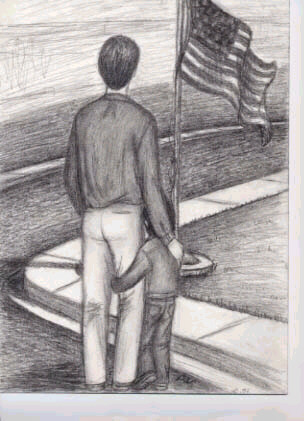
Papa,
Trevor, and the Flag.
*Sketch of Papa, Trevor, and the
Flag by Ria. Please click on Ria’s name if you’d like to send her feedback
regarding her beautiful sketch.
*Trevor Gage appears in two other
stories in Kenda’s Emergency! Library. Dancing With The Devil and The Phantom And The
Parselmouth.